
Healing Through Organization: How Your Environment Impacts Your Nervous System

There is something powerful about walking into a space in your home and feeling like you can finally exhale. Maybe it’s because the counters are clear, you can easily find what you need, your favorite things are displayed where you can see them, or the room is beautiful in a way that feels like you. Maybe there is simply enough space to move through your day without constantly stepping around things, searching for something, or thinking about everything you still need to do.
For me, creating that kind of environment has been an important part of rebuilding my life. After my marriage ended and I began creating a new life for myself, I already knew how much my physical environment could influence how I felt from my design experience. So it was a priority for me to invest in my new space - one that was completely my own, without needing to adapt it to anyone else. Organizing my home in the ways I wanted to gave me room to breathe. It allowed me to create an environment that felt like me again: calm, beautiful, feminine, simple, functional, and peaceful.
It wasn't about creating a perfect home. It was about creating a home that supported the person I was becoming.
And that distinction matters.
Your home is not just where you keep your belongings. It is where you experience so much of your everyday life, and it can become a sanctuary that supports you throughout your healing journey. The way your environment is arranged can influence how easily you move through your routines, how much mental energy you spend looking for things or making decisions, and how peaceful or overwhelmed you may feel in your own space.
Organization, then, can become about so much more than putting things away. It can become an act of self-support.
Your Home Is Constantly Communicating With You
We often think about stress as something that comes from major events or obvious circumstances, but there are also the small, constant sources of friction that we encounter throughout the day. A pile of paperwork sitting on the counter, a closet that is difficult to navigate and causes you to run late for work in the mornings, a kitchen where you can't easily find the things you use every day, or a bedroom that has gradually become a storage area can all create a subtle sense that there is always something else to deal with.
None of these things necessarily feel significant on their own. But when your environment repeatedly presents you with visual reminders of unfinished tasks, decisions, or responsibilities, your home can unintentionally become another source of mental noise rather than the place where you go to recover from the noise of the outside world.
You may walk into a room and immediately start thinking, I need to deal with this. I need to clean that. Where did I put that? I really need to get organized. I'm so behind.
And for some people, visual clutter is particularly overwhelming. I know it is for me. When I enter a cluttered or chaotic space, I can feel overwhelmed or anxious, and sometimes I don't even know where to begin. There can be so much visual information competing for my attention that instead of becoming more productive, I can become scattered and make an even bigger mess trying to figure out what to tackle first.
That experience has helped me understand something important: sometimes the problem isn't that we don't want to get organized. We simply don't know where to start.
When Overwhelm Makes Organization Harder
This is something I see with organizing clients, too. People sometimes assume that someone with a disorganized home simply needs more discipline, but that usually isn't the whole story.
A person may be overwhelmed to the point that they don't have the energy or clarity to figure out what needs to happen next. They may not have learned organizing skills that work for them, may not have systems in place, or may be living in a space that simply isn't laid out in a way that supports how they actually live.
Sometimes the accumulation happens gradually. One thing doesn't get put away, then another. A busy week becomes a busy month. A project gets interrupted. Life gets complicated. Eventually, there is so much to sort through that the thought of beginning feels overwhelming in itself.
Then shame can enter the picture.
"Why can't I keep up with this?"
"Why can't I just get it together?"
"Other people seem to manage this just fine."
But clutter is not a moral failure. Having a disorganized home does not mean that you are lazy, incapable, or doing life incorrectly. Sometimes you are simply overwhelmed, and when you're overwhelmed, the answer isn't necessarily to criticize yourself into becoming more organized.
Sometimes the first step is compassion.
Organization Isn't About Copying Someone Else’s Home
Organization doesn't have to mean a minimalist house with empty countertops, perfectly folded towels, matching containers, or a home that looks like it belongs in a magazine. It also doesn't mean that there is one universally correct way to organize a home.
What works beautifully for one person may be completely impractical for someone else. A highly minimalist environment might feel peaceful to one person and sterile to another. Open shelving might make one person feel inspired while making another person feel overwhelmed by visual clutter. Someone might thrive with detailed systems and labeled containers, while someone else may need simple systems with as few steps as possible. One person might want almost everything tucked away, while another might need frequently used items visible and within easy reach.
Neither person is wrong.
The goal isn't to create the "right" home. The goal is to create the right home for you.
That means considering your strengths, your challenges, your habits, your routines, your goals, your dreams, your aesthetic preferences, and, perhaps most importantly, how you want to feel when you are there.
This is something I want to emphasize throughout my work because I don't believe there is a single blueprint for a peaceful, organized, or beautiful home. What I want for my own space can be very different from what someone else needs. The environment that helps me feel calm may feel restrictive to someone else, while the systems that make my day flow easily may be completely impractical for another person's habits or circumstances.
The process has to begin with getting curious about yourself. What works well for you? What tends to trip you up? What are your natural strengths? Where do you struggle? How can your home better support you as you move through your day? What do you want it to feel like when you walk through the door?
Those questions are much more valuable than simply asking what an organized home is supposed to look like.
Your Organizing System Should Work With You
One of the most important principles I've learned is that a system only works if it works for the person using it. You can create the most beautiful organizational system in the world, but if it requires habits that don't naturally fit the person, it probably won't last.
This is why understanding yourself matters. If you tend to forget things when they're hidden away, perhaps some of your frequently used belongings need to remain visible. If visual clutter overwhelms you, closed storage might help create a calmer environment. If you struggle with complicated routines, your systems may need to be incredibly simple. If you have a busy family household, everyone may need to understand where things belong - not just the person who organized everything.
And if aesthetics are important to you, creating a beautiful environment may be part of what makes you feel peaceful and inspired. For someone else, aesthetics may be secondary to accessibility or function. Neither approach is more correct.
There is no universal formula. Good organization meets you where you are.
For me, one of the most important principles is that everything needs a home. When something has a designated place to return to, putting it away becomes much easier. In a family environment, it becomes even more important that everyone knows what that home is.
But even that principle needs flexibility. The "home" for something should make sense based on how often you use it, where you use it, who uses it, and how easily you need to access it.
The system should serve your life. Your life shouldn't have to constantly accommodate the system.
Less Visual Noise Can Create More Space to Breathe
For me personally, reducing visual clutter has an enormous impact. When there is too much competing for my attention, I can feel it almost immediately. That's why I love spaces where the things that remain visible are intentional - not because everything needs to be hidden or because your home needs to look sparse, but because there is a difference between a space that feels visually alive and one that feels visually demanding.
Sometimes creating calm simply means giving your eyes somewhere to rest. Clearing a surface, putting away the things that don't need to be out, grouping similar items together, removing things that no longer serve you, and creating a home for the objects you use regularly can all make an environment feel less complicated.
You don't necessarily need to transform your entire house to begin experiencing that difference. Sometimes one clear surface, one organized drawer, or one room that feels more open to move through can create a small pocket of relief.
And those small pockets of relief matter.
Organization Can Be an Act of Self-Support
This is ultimately why I don't think organization should be viewed simply as productivity. Yes, a well-organized home can help you get things done, but I think its deeper purpose is that it can make living easier.
Imagine opening your kitchen cabinet and immediately finding what you need. Getting dressed without digging through a crowded closet. Walking into your bedroom and feeling invited to rest rather than reminded of everything you haven't finished. Finding your important paperwork when you need it. Coming home and knowing exactly where your keys belong. Moving through your morning without having to make dozens of unnecessary decisions.
These aren't glamorous things, but they matter. Every little bit of friction we remove from our everyday environment can create more room for something else: more room for rest, creativity, connection, or simply being present in our own lives.
That is one of the reasons I love organization so much. At its best, it isn't about squeezing more productivity out of yourself. It is about removing unnecessary obstacles so you have more capacity for the things that matter to you.
Your Home Should Support the Life You Want to Live
One of my favorite questions when thinking about a home is: What do you want your home to make easier?
Maybe you want to cook more, exercise regularly, spend more time reading, entertain friends, or make your mornings feel calmer. Maybe you are building a business from home, or perhaps you are entering a completely new chapter of your life and want your surroundings to reflect who you are now.
Your organization should support those goals. If you want to cook more plant-based meals, your kitchen should make the foods and tools you use most accessible. If you want to rest more, your bedroom should feel peaceful rather than becoming an extension of your workspace. If you want to spend more time creating, your creative supplies should be accessible enough that getting started doesn't feel like an enormous project. If you want your mornings to feel calmer, your entryway, bathroom, closet, and kitchen can all be arranged to reduce unnecessary decisions and searching.
This is where organization becomes much more personal.
You aren't organizing a house. You're supporting a life.
The best systems aren't necessarily the ones that look the most impressive. They are the ones that quietly make your particular life move more smoothly.
Creating a Home That Feels Like You
There is another layer to organization that I think we sometimes overlook. Our belongings can carry memories. They can represent relationships, past identities, obligations, dreams we once had, and versions of ourselves we have outgrown. Sometimes organizing a space brings us face-to-face with those things, which can make letting go surprisingly emotional.
But you don't have to force yourself to discard everything associated with your past in order to move forward. You can approach your belongings with curiosity and compassion. Does this still represent me? Does this support the life I'm living now? Do I actually use it? Do I love it? Am I keeping this because it brings me joy, or because I feel guilty letting it go?
Sometimes the answer will be to keep something. Sometimes it will be to let it go. Sometimes it will simply be to move it somewhere that makes more sense. There is no perfect answer. The point is to become more intentional about the relationship between your belongings and your life.
This can be especially meaningful during periods of transition. When you're rebuilding after a difficult chapter, your environment can become a place where you begin expressing your identity again. You can choose what belongs in this chapter of your life, what no longer does, and what you want to make room for next.
For me, that was part of what made creating my own space after my marriage so meaningful. I wasn't simply organizing rooms. I was creating an environment that felt like mine. I could make choices based on how I wanted to live and how I wanted to feel, rather than constantly adapting my surroundings to someone else's preferences or needs. There was something deeply freeing about that.
Start Small
If your home currently feels overwhelming, you don't need to organize everything at once. In fact, trying to do that may create even more overwhelm. Instead, choose one small area: your nightstand, one kitchen drawer, your bathroom counter, the entryway, one shelf, or one category of paperwork.
Choose somewhere that you interact with regularly and ask yourself, What would make this space easier for me to use?
Not, How can I make this perfect? Not, How would someone else organize this? Simply, What would make this easier for me?
That question puts you back at the center of the process. As you create one small area of ease, you may begin to understand what your home needs more clearly. You may discover that you need more closed storage, fewer possessions, quicker access to certain items, a simpler routine, or perhaps simply a better layout.
Organization can become a process of listening to your environment and listening to yourself.
There Is No One Right Way to Create a Peaceful Home
This may be the most important thing I want you to take away from this entire conversation: your peaceful home may not look like mine, and mine doesn't need to look like yours.
My ideal environment is calm, beautiful, functional, and easy to move through. I want less visual clutter. I want things to be easy to find. I want my surroundings to feel peaceful and aesthetically pleasing. I want my home to feel like a place where I can relax and breathe.
But your version of peace might be completely different. Maybe you love color and pattern. Maybe you want your collections displayed everywhere. Maybe you thrive with open shelving and visible belongings. Maybe you prefer minimalism. Maybe you need a creative amount of organized chaos. Maybe you want a cozy, layered home full of books, art, and meaningful objects.
Your circumstances matter, too. You may have young children, pets, work, hobbies, changing energy levels, accessibility needs, or other realities that shape what your home needs from you. What works for someone living alone may not work for a family. What works in one season of your life may not work in another.
Your home doesn't have to fit someone else's definition of beautiful, organized, peaceful, or successful.
It needs to fit you.
Explore what supports your strengths. Accommodate your challenges. Consider your habits. Make room for your dreams. Honor your aesthetic. And most importantly, pay attention to how your environment makes you feel.
Because your home is one of the few places in the world where you get to intentionally shape your surroundings around the life you want to live.
Your Home Can Become a Place to Exhale
Healing doesn't happen only in our thoughts. It also happens in the lives we build around ourselves. Sometimes that means setting a boundary. Sometimes it means resting. Sometimes it means learning to trust yourself again. And sometimes it means clearing the kitchen counter, creating a home for your keys, letting go of the things you no longer need, or rearranging a room so that your everyday life flows more easily.
These things may seem small, but small things can change how we experience our days. When our surroundings ask a little less of us, we may have more room to rest, create, connect, and simply be present. When our homes reflect who we are and support the way we actually live, they can become more than functional spaces. They can become places of restoration.
Your home doesn't need to be perfect to be peaceful. It doesn't need to be spotless to be supportive. You don't have to become a different person to deserve an organized, beautiful, functional environment.
Instead, start with where you are. Get curious about what you need. Create systems that work with you rather than against you. Let go of the standards that don't belong to you. And slowly, intentionally, create a space that feels like home.
Because your home is more than a collection of rooms and belongings. It is the environment in which you are living your life.
You deserve an environment that helps you breathe, supports you, reflects who you are becoming, and allows you to feel that you can finally exhale when you walk through the door. 💚
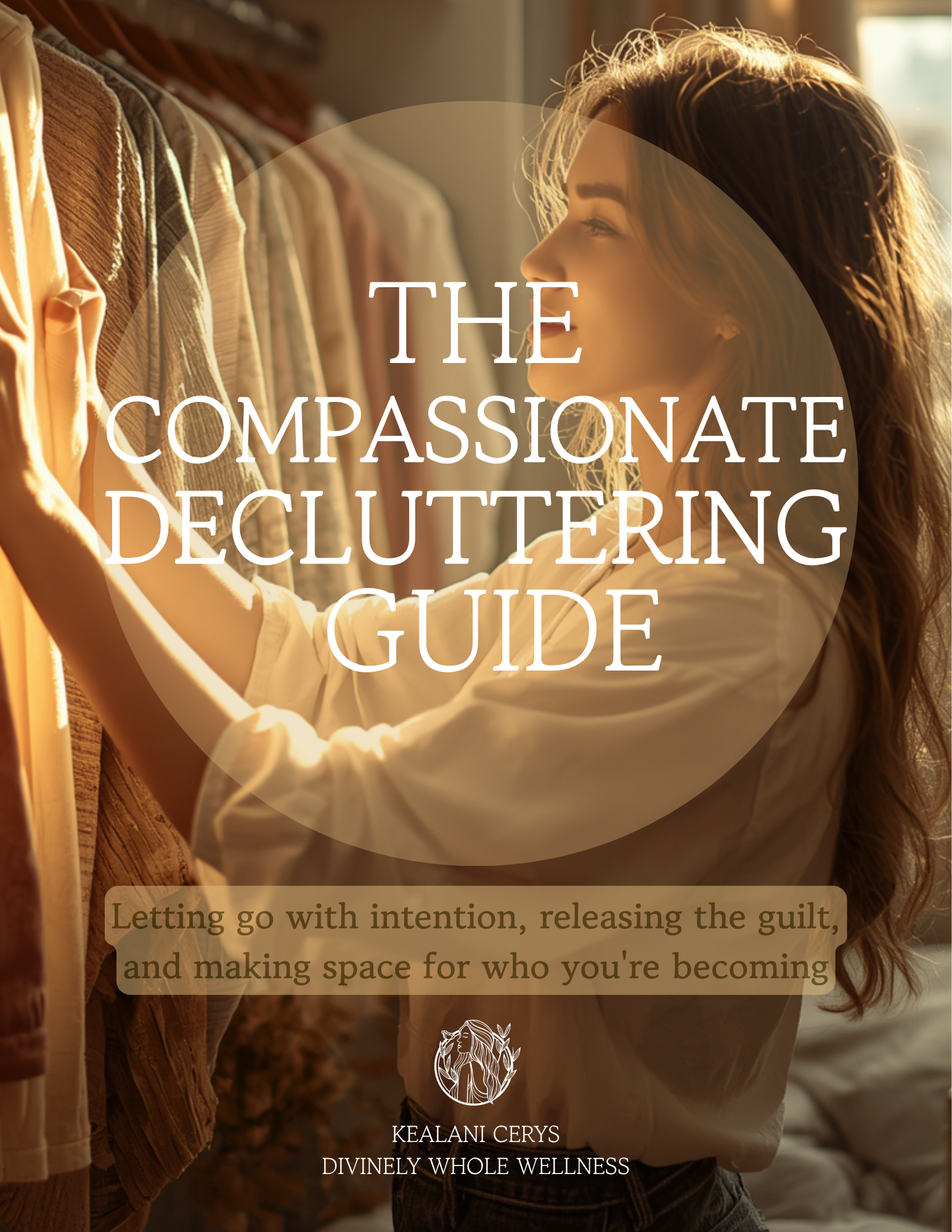
Decluttering Workbook
Decluttering isn't always about having too much stuff. Sometimes, it's about struggling to let go of what our belongings represent: memories, gifts, money we've spent, or versions of ourselves we've outgrown. The Compassionate Decluttering Guide helps you understand the emotional side of letting go while giving you practical tools to make thoughtful decisions about what truly belongs in your home.